
If you work in healthcare anywhere in Maryland, from a clinic in Annapolis to a hospital floor in Baltimore, you have probably been asked whether your BLS card is current, or whether you also need ACLS. The two certifications sound similar, and both come from the American Heart Association, so it is easy to see why people mix them up.
They are not the same thing, though, and choosing the wrong one can cost you time, money, and in some cases, a job offer. This guide breaks down what BLS certification in Maryland and ACLS certification in Maryland actually involve, who needs each one, how the courses differ in length and content, and how to get certified quickly through Maryland CPR Classes.
BLS Certification: What the Training Covers
BLS stands for Basic Life Support. It is the foundation level of resuscitation training set by the American Heart Association, and it is built for anyone who might be the first person to respond when someone’s heart stops or they stop breathing.
The BLS course teaches high-quality chest compressions for adults, children, and infants, rescue breathing, how to clear an airway obstruction, and how to use an AED (automated external defibrillator) safely. It also covers team-based resuscitation, which means knowing how to work alongside other rescuers during a code instead of getting in each other’s way. Bag valve mask ventilation and the use of a barrier device are also part of the skills check.
BLS is meant to be approachable. You do not need years of clinical experience to take it, but it is still a Healthcare Provider-level course, not a general public class. Nursing students, dental assistants, EMT candidates, CNAs, and anyone entering a clinical or allied health role take the same core course. If you are a member of the public looking for a CPR card for personal or workplace use rather than a healthcare job or clinical rotation, the AHA’s Heartsaver CPR/AED course is usually the better fit, since it covers similar skills without the healthcare-specific scenarios.
At Maryland CPR Classes, BLS is offered in two formats:
- BLS Online & Skills ($120): you complete the HeartCode BLS online module at your own pace, then finish with a short, in person skills check at a self guided AHA verification station, usually around 30 minutes.
- BLS Skills only ($90): for students who already completed the online cognitive portion elsewhere, or who are renewing and just need the hands on skills check.
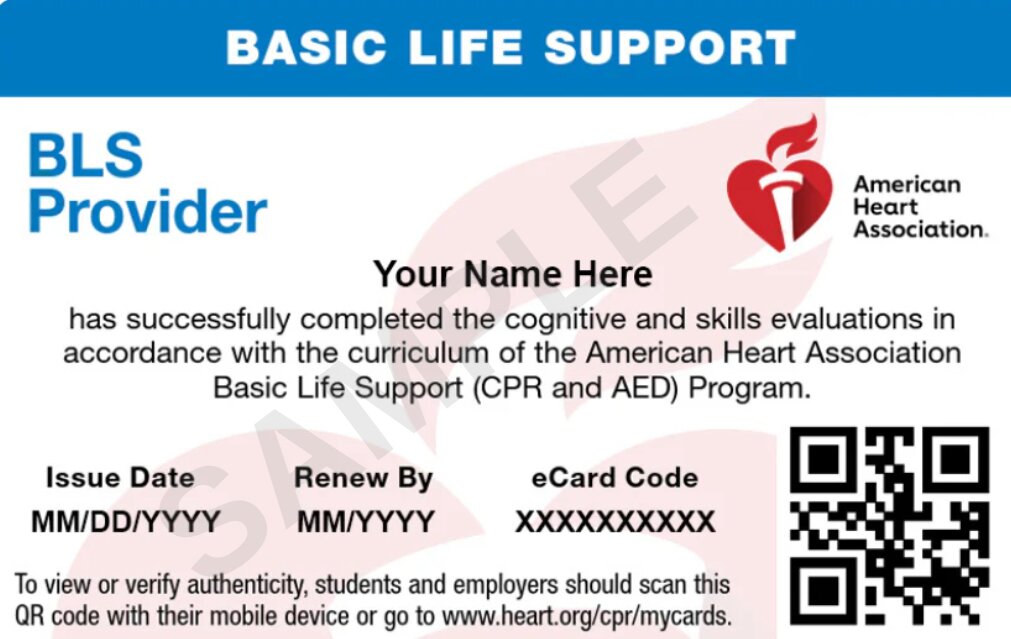
Both options end with an instant AHA BLS Provider eCard issued the same day, and both allow unlimited attempts on the skills station so you are not penalized for needing a second try.
ACLS Certification: What the Training Covers
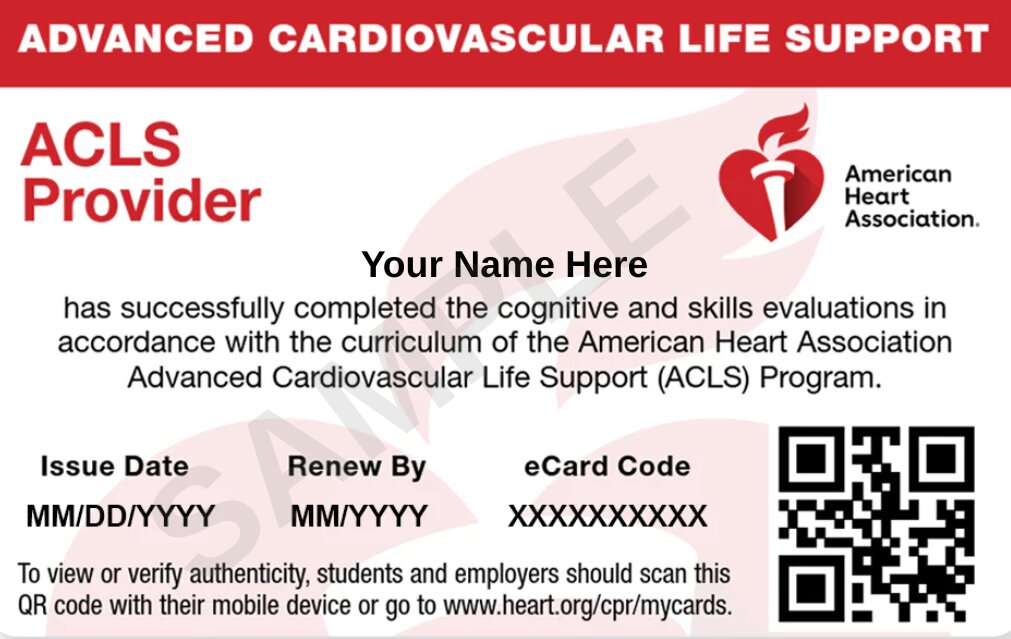
ACLS stands for Advanced Cardiovascular Life Support. Think of it as BLS plus a layer of clinical decision making built on top. Where BLS is about recognizing an emergency and starting compressions, ACLS is about managing the full resuscitation event once advanced help and equipment are available.
The ACLS course covers the AHA’s cardiac arrest algorithms, including the management of pulseless rhythms like ventricular fibrillation and ventricular tachycardia, recognition of bradycardia and tachycardia, and the early steps for stroke and acute coronary syndrome. Students also work through resuscitation pharmacology, learn to read and interpret ECG rhythms relevant to a code, practice airway management beyond a basic bag mask, and take on team leadership roles during a simulated cardiac arrest.
Because ACLS assumes a working knowledge of BLS skills and basic ECG interpretation, it is typically taken by nurses, physicians, physician assistants, nurse practitioners, paramedics, and respiratory therapists, especially those working in emergency departments, ICUs, cath labs, and other critical care settings.
Maryland CPR Classes offers ACLS in the same two part structure as BLS:
- ACLS Online & Skills ($295): online HeartCode ACLS coursework followed by an in person skills evaluation.
- ACLS Skills only ($150): for providers who completed the online portion separately or who are recertifying and only need the hands on component.
Both paths lead to a same day, instant AHA ACLS Provider eCard with unlimited attempts at the skills station.
ACLS vs. BLS: Key Differences at a Glance
| Feature | BLS Certification | ACLS Certification |
| Full name | Basic Life Support | Advanced Cardiovascular Life Support |
| For | Healthcare students and entry-level clinical roles | Nurses, physicians, paramedics, and advanced clinical staff |
| Core focus | Recognizing cardiac arrest, starting CPR, and using an AED | Managing the full resuscitation event with drugs, rhythms, and team leadership |
| Certification validity | 2 years | 2 years |
Course Curriculum: What BLS and ACLS Actually Teach
Price and format are the easy differences to spot. The real gap between these two courses sits in the curriculum, since BLS and ACLS train you for two different moments in a resuscitation.
Inside the BLS Curriculum
BLS is built around the Chain of Survival, the sequence of actions that gives someone in cardiac arrest the best chance at a good outcome: early recognition, early CPR, early defibrillation, and early access to advanced care. The whole course supports that sequence.
Students learn the exact mechanics behind high quality CPR, not just the general idea of pushing hard and fast. That includes a compression rate of 100 to 120 per minute, a compression depth of at least two inches for adults, full chest recoil between compressions, and minimizing pauses so blood keeps moving to the brain and heart. The course also covers the compression to ventilation ratio for a single rescuer (30 compressions to 2 breaths) and the adjusted ratio for two rescuer infant and child CPR (15 compressions to 2 breaths).
Beyond compressions, the BLS curriculum covers AED operation from power on to shock delivery, relief of choking in a conscious adult, child, and infant, and switching to CPR if the person becomes unresponsive. Team based skills round out the course: clear communication during a two person resuscitation, switching compressors without losing rhythm, and coordinating bag valve mask ventilation with a partner.
Inside the ACLS Curriculum
ACLS picks up where BLS leaves off. Instead of one rescuer doing compressions, ACLS trains a small team to run an entire resuscitation, including medications, rhythm interpretation, and decision making under pressure.
The course is built around the AHA’s core algorithms, and most of class time goes toward learning each one:
- Cardiac Arrest Algorithm: splits into two pathways depending on the rhythm. Shockable rhythms, ventricular fibrillation and pulseless ventricular tachycardia, need defibrillation. Non-shockable rhythms, asystole and pulseless electrical activity, rely on high quality CPR and medications instead.
- Bradycardia Algorithm: covers when a slow heart rate needs atropine, transcutaneous pacing, or another intervention.
- Tachycardia Algorithm: covers the difference between a stable and unstable fast heart rate, vagal maneuvers, adenosine for certain rhythms, and synchronized cardioversion when the patient is unstable.
- Acute Coronary Syndrome Algorithm: covers early recognition of a heart attack and the steps that get a patient to definitive treatment faster.
- Suspected Stroke Algorithm: covers rapid stroke recognition and the time sensitive decisions that affect treatment options.
Students also learn the “H’s and T’s,” a memory tool for the reversible causes of cardiac arrest such as hypoxia, hypovolemia, and tension pneumothorax, along with the doses and timing for resuscitation drugs like epinephrine, amiodarone, and atropine. Rhythm recognition carries more weight in ACLS than in BLS, since providers need to read a strip and choose a treatment, not just confirm a pulse is absent.
Team dynamics get more attention here too. Students practice closed loop communication, take turns leading a simulated code, and assign clear roles to teammates, since a real resuscitation involves several people working at once instead of one rescuer.
Who Actually Needs BLS Certification in Maryland?
BLS is the broader certification, so the list of people who need it is long. In Maryland, this typically includes nursing students before they start clinical rotations, CNAs and patient care technicians, dental hygienists and dental assistants, medical assistants, EMT candidates working toward state licensure through MIEMSS, school nurses, and anyone entering a healthcare role where the employer requires a Healthcare Provider level card rather than a layperson CPR card. If your role is not clinical, such as a lifeguard, personal trainer, teacher, or general childcare worker, your employer most likely accepts the AHA’s Heartsaver CPR/AED course instead, since that is the certification built for non-healthcare roles.
Hospitals and health systems across Maryland, including large employers in Baltimore and the DC metro area, generally require new clinical hires to walk in on day one with a current BLS card. If you are applying to nursing school in Maryland or starting a clinical placement, BLS is almost always the first certification your program will ask for.
Who Actually Needs ACLS Certification in Maryland?
ACLS is aimed at providers who are expected to actively manage a cardiac emergency rather than just start CPR and call for help. In Maryland, this usually applies to registered nurses working in emergency departments, intensive care units, telemetry, or cardiac catheterization labs, physicians and physician assistants in emergency or critical care medicine, nurse practitioners in acute care roles, paramedics, and respiratory therapists.
If your job title involves the words “ICU,” “ER,” “critical care,” or “cath lab,” there is a strong chance your employer will list ACLS as a condition of employment, alongside BLS. Many Maryland hospitals also require nurses on med-surg or telemetry floors to hold ACLS even if they are not expected to run a code independently, simply so they understand the algorithm being followed when the code team arrives.
Maryland-Specific Requirements You Should Know
The Maryland Board of Nursing does not directly mandate BLS or ACLS for nursing licensure itself. That requirement almost always comes from the employer or facility, not the state licensing board. In practice, this means the rules are set by the hospital, clinic, or agency you work for, and most Maryland healthcare employers require a current AHA Healthcare Provider BLS card as a baseline, with ACLS added for critical care and emergency roles.
This is an important distinction because it means you should always check with your specific employer, school, or clinical program about which certification they accept before you register. Some Maryland facilities only accept AHA cards specifically, rather than other certifying organizations, which is one reason healthcare professionals across the state look for AHA authorized training centers like Maryland CPR Classes.
For EMTs and paramedics, certification requirements run through the Maryland Institute for Emergency Medical Services Systems (MIEMSS), which sets its own training standards for EMS licensure. BLS is part of that pathway for EMTs, and ACLS is commonly required for paramedic level providers.
Do You Need BLS Before You Can Take ACLS?
In most cases, yes. The American Heart Association designs the ACLS course assuming students already understand BLS level CPR skills and basic cardiac rhythm concepts. While some training centers will technically let you sit the ACLS course without an active BLS card, you will be expected to keep up with compression technique, AED use, and airway basics that are taught in BLS, not retaught in ACLS.
If your BLS card is expired or you have never taken a healthcare provider CPR course before, the practical advice is simple: get your BLS certification current first, then move on to ACLS. This is also the order most nursing programs, hospitals, and EMS agencies expect to see on your training record.
How Certification Works at Maryland CPR Classes
Both ACLS and BLS follow the same convenient, two-step structure at Maryland CPR Classes, an American Heart Association training center.
Step 1: Complete the online coursework at your own pace.
Using AHA’s HeartCode platform, you work through the lessons and required knowledge checks on your own schedule, whether that is during a lunch break, between shifts, or late at night.
Step 2: Finish with an in person skills check.
ou attend a brief, hands on session at a self guided AHA verification station to demonstrate your skills on a manikin. These stations give real time feedback, so you know immediately if a compression or breath needs adjusting, and you get unlimited attempts to pass.
Once you complete the skills check successfully, you receive your AHA Provider eCard the same day. There is no waiting days for a card to arrive in the mail, and no need to retake the entire course if a single attempt does not go perfectly.
This format works well for busy nurses, students balancing clinical rotations, and anyone who simply does not have a full day to spend in a classroom. Maryland CPR Classes offers training sessions at locations throughout the state, including Baltimore City, Annapolis, Bethesda, Silver Spring, Towson, Frederick, Columbia, Glen Burnie, Gaithersburg, Hagerstown, Salisbury, and Waldorf, among others, so you can usually find a nearby option without much travel.
ACLS vs. BLS: Comparing the Cost in Maryland
Pricing is one of the most common questions for both certifications. Here is what to expect through Maryland CPR Classes:
| Course | What’s Included | Price |
| BLS Online & Skills | Online HeartCode BLS + in person skills check | $120 |
| BLS Skills Only | In person skills check only (for those who finished online elsewhere) | $90 |
| ACLS Online & Skills | Online HeartCode ACLS + in person skills check | $295 |
| ACLS Skills Only | In person skills check only (for those who finished online elsewhere) | $150 |
Read More About CPR Certification Costs in Maryland
How Often Do You Need to Recertify?
Both ACLS and BLS Provider eCards from the American Heart Association are valid for two years from the date you pass your course. Renewal works the same way as initial certification: complete the updated online refresher, then pass the hands on skills check. Many healthcare professionals build renewal into their calendar a month or two before expiration so there is no gap in active certification, since most Maryland employers will not allow staff to work clinical shifts with a lapsed card.
Which Certification Should You Choose?
If you are new to healthcare, working toward a nursing or allied health degree, or your job does not involve directly managing a code, BLS certification in Maryland is almost certainly the right starting point. It covers the skills every healthcare provider needs and satisfies most entry level employment and clinical requirements.
If you already work in or are moving into emergency medicine, critical care, cardiology, or EMS at the paramedic level, you will likely need both BLS and ACLS certification in Maryland. Check your job description or ask your manager directly. Many employers spell this out clearly, and getting it confirmed before you register saves you from paying for the wrong course.
Final Thoughts
BLS and ACLS serve different purposes, but they work together. BLS gives you the core skills every healthcare provider needs to respond to a cardiac or respiratory emergency. ACLS builds on that foundation with the clinical knowledge to manage a full resuscitation event as part of a code team.
Knowing which one your role requires, and getting it from an authorized AHA training center, keeps you compliant with employer and program requirements while making sure you are genuinely ready if you are ever the person closest to an emergency.
Maryland CPR Classes offers both BLS and ACLS certification across locations throughout Maryland, with flexible online learning, fast in person skills checks, and same day AHA eCards. You can review course details and book a session for ACLS certification in Maryland or BLS certification in Maryland, or call (888) 840-5527 to speak with a member of the team about which certification fits your role.