
If you work in healthcare, you’ve probably had BLS certification listed as a job requirement before you even started your training. But what does the course actually teach, and how is it different from the general CPR classes offered to the public? This guide breaks down what BLS certification covers, who needs it, and how to get certified in Maryland through Maryland CPR Classes, an American Heart Association (AHA) training provider.
BLS Certification: What You Need to Know
BLS stands for Basic Life Support. It’s an AHA course built specifically for healthcare professionals and healthcare students, teaching the skills needed to recognize and respond to cardiac arrest, respiratory arrest, and choking in adults, children, and infants. Unlike general public CPR classes, BLS assumes you’re working in or heading into a clinical environment, so it trains you to perform high-quality CPR both alone and as part of a coordinated team.
The course centers on the idea that early, high-quality CPR combined with rapid defibrillation gives a patient the best chance of survival. You’ll learn the exact mechanics behind effective compressions, proper ventilation technique, and how to use an AED correctly, along with how to fit into a resuscitation team without wasting time or duplicating effort.
BLS certification through the AHA is valid for two years. After that, you’ll need to recertify to stay current with updated science and protocols.
What the AHA BLS Course Actually Covers
A lot of people assume BLS is just “CPR training with a certificate,” but the course goes into real depth on technique and team performance.
High-quality CPR mechanics: You’ll practice compressions at the correct rate and depth, full chest recoil between compressions, and minimizing interruptions, since even short pauses in compressions reduce blood flow to vital organs.
Adult, child, and infant response: BLS covers CPR technique across all three age groups, since the approach to compression depth, hand placement, and ventilation changes based on patient size.
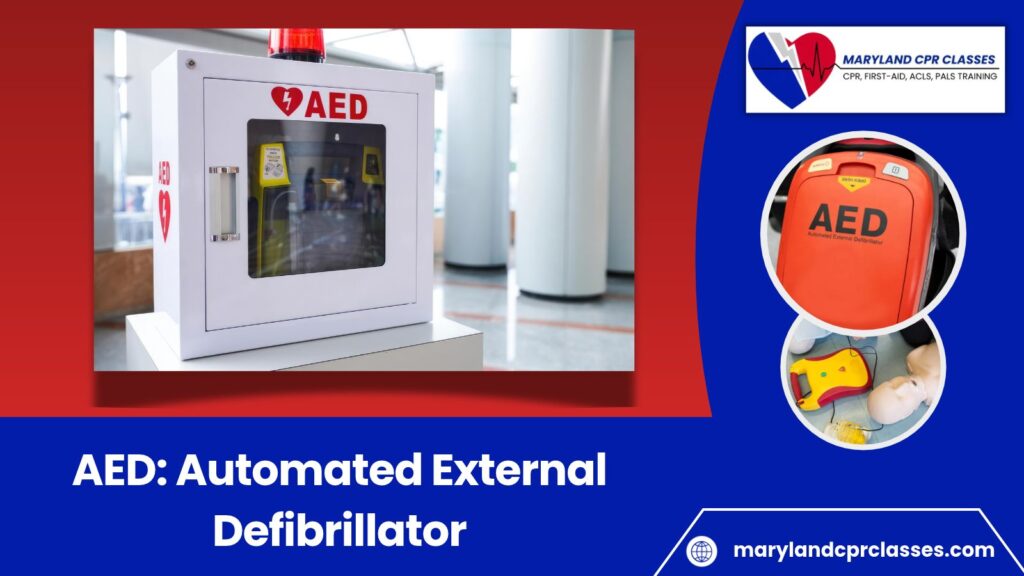
AED use: You’ll practice applying and operating an AED correctly, including how to handle special situations like a patient with a pacemaker or one who is in water.
Airway management and rescue breathing: This includes bag-mask ventilation technique, a skill that’s harder to perform correctly than most people expect and gets real practice time in the course.
Choking relief: You’ll learn how to recognize and respond to airway obstruction in adults, children, and infants.
Team dynamics: BLS puts real emphasis on functioning as part of a multi-rescuer response, including clear communication, role assignment, and how to switch compressors without breaking rhythm.
This combination of individual skill and team coordination is what separates BLS from a general public CPR class. You’re not just learning to respond alone. You’re learning to slot into a hospital code team or an EMS response without missing a beat.
Who Needs BLS Certification in Maryland
BLS certification is typically required, not optional, for a wide range of roles across Maryland’s healthcare system:
- Nurses, across hospital units, outpatient clinics, and long-term care facilities
- Physicians and physician assistants
- EMTs and paramedics
- Medical assistants
- Respiratory therapists
- Dental professionals, including dentists and dental hygienists
- Nursing, medical, and allied health students, who often need current BLS before starting clinical rotations
- Hospital and clinic support staff whose roles bring them into contact with patients
If you’re a student heading into a clinical program, check your program’s requirements early. Many nursing and allied health programs won’t let you start rotations without a current BLS card in hand, and scheduling a class the week before your rotation begins is cutting it closer than you want.
BLS vs Heartsaver CPR AED: Which One Do You Need?
This trips up a lot of people, since both courses teach CPR and AED skills. The difference comes down to your role and your training level.
BLS is built for healthcare professionals and students. It assumes some baseline clinical knowledge, goes deeper into team-based resuscitation, and is generally what hospitals, clinics, and healthcare employers require for staff with direct or indirect patient contact.
Heartsaver CPR AED and Heartsaver First Aid CPR AED are built for lay rescuers, meaning people without a clinical background. These courses cover the same core CPR and AED skills at a level appropriate for teachers, coaches, childcare staff, workplace employees, and general community members. If your employer isn’t a healthcare setting, or if you’re pursuing certification for personal readiness rather than a clinical job requirement, Heartsaver is usually the right fit.
If you’re not sure which one your job or program requires, check your job description or ask your supervisor directly before registering. Taking the wrong course means paying for two certifications instead of one.
How to Get BLS Certified in Maryland
Maryland CPR Classes offers a training format built around how healthcare schedules actually work, since finding a full day for an in-person class isn’t realistic for most working professionals.
Self-Guided Learning lets you complete the online coursework for BLS at your own pace, from any device, before completing your hands-on skills check. This is the format most working nurses, EMTs, and healthcare students choose, since it fits around shift work instead of requiring a specific class date.
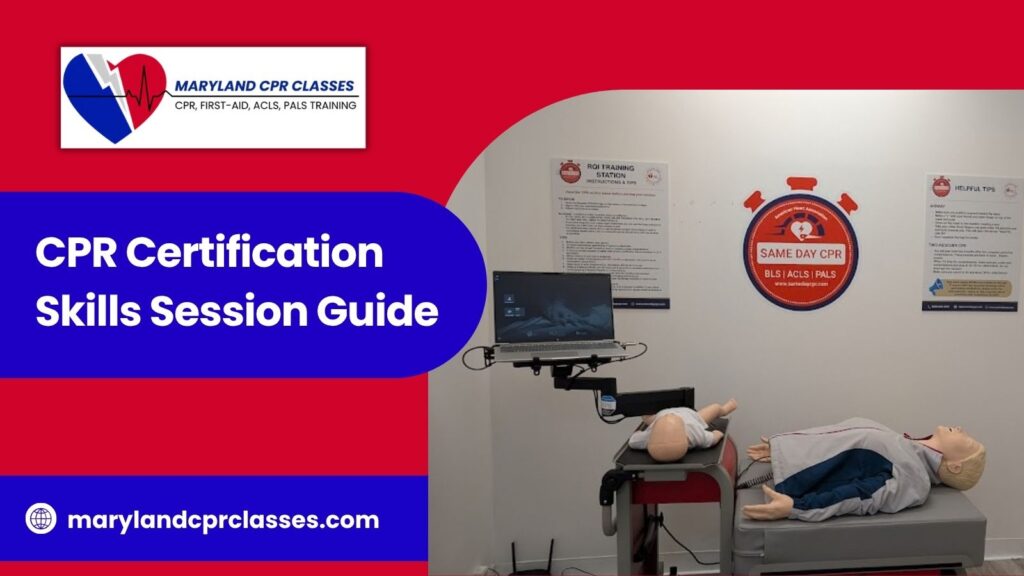
Once the online coursework is done, you’ll visit a CPR Verification Station near you for a focused, in-person skills session. These stations use Voice-Assisted Manikins, which give real-time feedback on your compression depth and rate as you practice and complete your skills test. The session is efficient, since the coursework already covered the material and the in-person time is spent purely on demonstrating your skills.
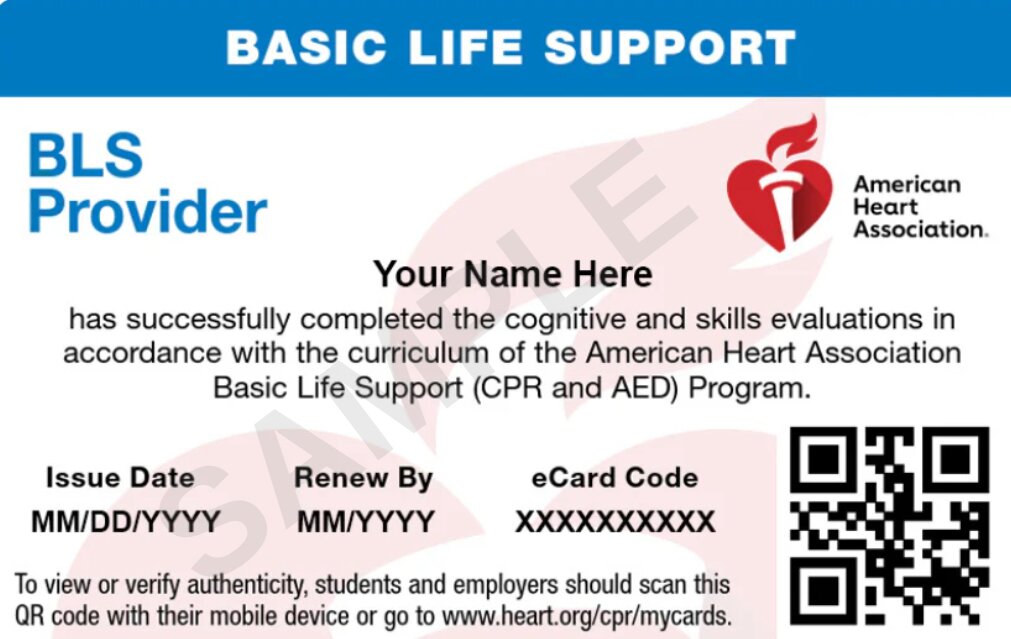
Pass your skills check and you’ll receive your official AHA BLS eCard the same day, ready to show your employer or clinical program. If you don’t pass on the first attempt, you can try again.
Maryland CPR Classes operates locations across the state, including Annapolis, Baltimore City, Bethesda, Columbia, Frederick, Gaithersburg, Hagerstown, Salisbury, Silver Spring, Towson, and Ocean City, along with several other Maryland counties, so finding a nearby skills session shouldn’t mean a long drive.
If Self-Guided Learning doesn’t fit your situation, Self-Paced CPR Certification options are also available for providers who want maximum flexibility around rotating shifts or multiple jobs.
BLS Renewal and Recertification in Maryland
Your BLS card is valid for two years from the completion date. AHA guidelines get updated periodically as new resuscitation science comes out, so recertification isn’t just paperwork. It’s how you stay current with the latest evidence-based techniques.
Recertification follows the same Self-Guided Learning structure as your initial course: complete the updated online material, then verify your skills at a CPR Verification Station. Most providers find recertification faster than their first course, since they’re refreshing existing skills instead of learning everything from scratch.
Set a reminder before your card expires. A lapsed BLS certification can affect your ability to work clinical shifts, and some employers require proof of current certification before every shift, not just at hire.
Group and On-Site BLS Training for Maryland Organizations
Hospitals, clinics, EMS agencies, and nursing schools often need to certify or recertify large groups of staff at once, which can be difficult to coordinate around individual schedules. Maryland CPR Classes offers group and on-site training options for organizations that want to run certification days without sending staff offsite individually.
Maryland CPR Classes also rents CPR Verification Stations directly to organizations, giving training coordinators the ability to set up ongoing skills verification on-site, on their own schedule, rather than booking sessions one at a time.
Getting Certified the Right Way
BLS certification gives healthcare professionals the specific, team-based resuscitation skills that general CPR training doesn’t cover, and most Maryland healthcare employers treat it as a non-negotiable requirement. Maryland CPR Classes offers AHA BLS certification through Self-Guided Learning and CPR Verification Stations across the state, with same-day eCards and flexible scheduling built around shift work.
Ready to get certified? Browse upcoming BLS course dates at Maryland CPR Classes and reserve a spot that fits your schedule.
Frequently Asked Questions
Is BLS certification the same as CPR certification?
BLS includes CPR and AED skills but goes further, adding team-based resuscitation, airway management, and healthcare-specific scenarios. It’s built for healthcare professionals and students, while general CPR classes for the public are typically covered under Heartsaver-level courses.
How long is BLS certification valid?
Two years from the completion date. After that, recertification is required to keep your card current.
Can I complete BLS certification entirely online?
The online coursework can be completed at your own pace through Self-Guided Learning, but AHA certification also requires an in-person hands-on skills session at a CPR Verification Station. A card isn’t issued until your skills are verified in person.