
Heartsaver CPR is the American Heart Association’s CPR and AED course built for people without a medical background. It’s the certification most teachers, coaches, fitness instructors, childcare staff, and workplace employees end up taking, since it teaches real, usable skills without assuming you’ve ever set foot in a clinical setting. If you’ve seen “Heartsaver” listed as a job requirement, a school volunteer requirement, or something your gym or workplace is asking for, this guide explains exactly what the course covers and whether it’s the right one for your situation.
What Is Heartsaver CPR?
Heartsaver CPR is part of the AHA’s lay-rescuer course line, meaning it’s designed for the general public rather than healthcare professionals. The course assumes no prior medical training and focuses entirely on what an everyday person needs to know to respond confidently if someone collapses, stops breathing, or starts choking in front of them.
This is different from courses like BLS, ACLS, or PALS, which are built for nurses, EMTs, and other healthcare providers and go into team-based resuscitation and clinical decision-making. Heartsaver strips that down to the practical core: recognize the emergency, call for help, and act, whether you’re alone with the person or waiting for EMS to arrive.
What Does the Heartsaver CPR AED Course Cover?
The Heartsaver CPR AED course teaches CPR and AED use across three age groups: adults, children, and infants, since the technique changes depending on who you’re helping. You’ll practice proper hand placement and compression depth for each age group, along with rescue breathing technique.
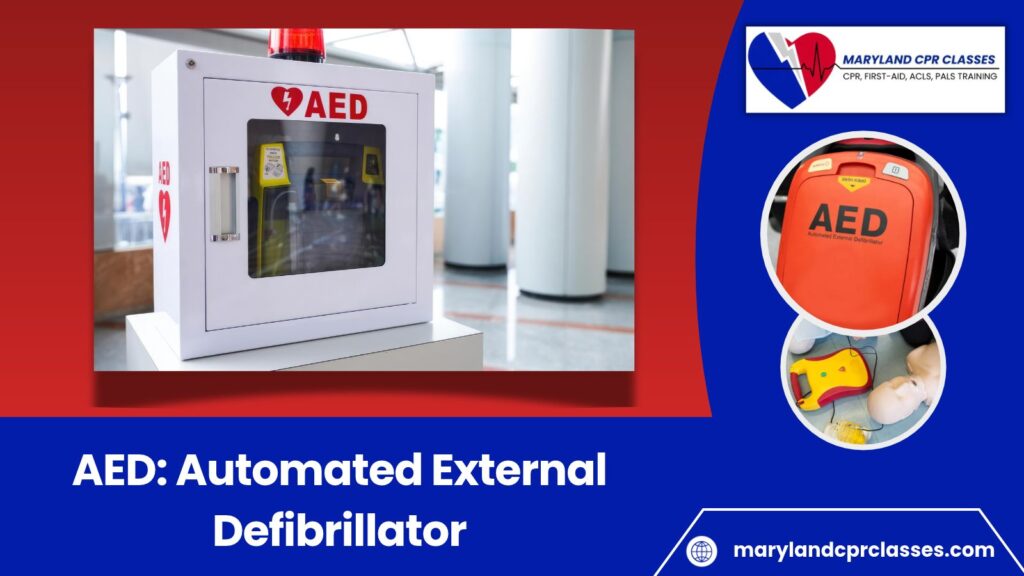
AED training is a core part of the course. You’ll learn how to apply the pads correctly, how the device walks you through the process, and how to handle situations that aren’t textbook, like a patient who’s wet from rain or sweat, or one with a pacemaker. Choking relief is also covered, since airway obstruction is one of the more common emergencies a bystander might actually encounter, whether it’s a coworker in a break room or a child at a birthday party.
Regardless of which training format you choose, classroom, blended, or self-guided, the course always includes a hands-on skills evaluation. You don’t get an AHA certification by watching a video and answering quiz questions. You have to demonstrate the skills.
Heartsaver CPR AED vs Heartsaver First Aid CPR AED
Maryland CPR Classes offers both, and the difference is simple. Heartsaver CPR AED covers exactly what’s described above: CPR, AED use, and choking relief. Heartsaver First Aid CPR AED includes all of that plus a broader first aid module, covering things like bleeding control, burns, sprains, and how to respond to common injuries beyond a cardiac or breathing emergency.
If your requirement is specifically CPR and AED, Heartsaver CPR AED covers it. If your school, employer, or program asks for CPR and first aid together, which is common for teachers, coaches, and childcare-adjacent roles, Heartsaver First Aid CPR AED is the one that satisfies both in a single course.
Heartsaver vs BLS: Why the Level Matters
This is where people sometimes pick the wrong course. Heartsaver and BLS both teach CPR and AED skills, but they’re built for different audiences, and picking the wrong one can mean redoing your certification.
BLS assumes you’re working in or entering a clinical role. It goes into two-rescuer CPR, bag-valve-mask ventilation, and coordinated team response, since healthcare workers are usually responding to an emergency alongside other trained staff. Heartsaver is built around a single bystander responding alone, without assuming any clinical background or prior training.
If your job is in healthcare, nursing, EMS, medical assisting, or a hospital-adjacent role, your employer almost certainly wants BLS, not Heartsaver. If you’re a teacher, coach, personal trainer, childcare worker, or general employee whose job isn’t clinical, Heartsaver is very likely the right level. When in doubt, check your specific job posting or ask your employer directly before registering.
Who Actually Needs Heartsaver CPR Certification
Heartsaver certification shows up as a requirement or a strong recommendation across a wide range of roles and situations:
- Teachers and school staff, who may be asked to hold current CPR and first aid certification by their district
- Coaches and youth sports staff, especially in leagues that require certification for anyone supervising kids
- Fitness instructors, personal trainers, and gym staff, who work with people during physical exertion where cardiac events, though rare, do happen
- Childcare and camp staff, in roles where CPR certification is expected even outside licensed daycare settings
- Foster and adoptive parents, who are sometimes required to hold current CPR certification as part of the approval process
- Workplace employees, particularly where an employer has a designated safety team or wants trained staff on-site
- Hospitality and security staff, who may be the first person on the scene during a medical emergency involving a guest or visitor
- Faith community and nonprofit volunteers, who work with groups of people regularly and want to be prepared
- Parents, grandparents, and caregivers, who simply want the confidence to respond if something happens to a family member
If you fall into more than one of these categories, one Heartsaver certification typically covers all of them, since the skills themselves aren’t role-specific.
Is Heartsaver Certification Required by Law?
There’s no single Maryland law that requires every employer or organization to have Heartsaver-certified staff. Instead, the requirement usually comes from a specific source: a school district policy, a youth sports league’s insurance requirements, a gym’s staffing policy, a foster care licensing requirement, or an employer’s own safety standards. Some Maryland regulations, like those covering child care staffing, specifically require CPR training through the American Heart Association, and Heartsaver-level courses are commonly used to satisfy that kind of requirement.
If you’re not sure whether your specific situation legally requires certification or simply strongly recommends it, check with whoever is asking for it. Either way, the skills themselves are worth having regardless of whether a policy technically requires them.
How to Get Heartsaver Certified in Maryland
Maryland CPR Classes makes this straightforward, with a format built for people who don’t have a spare full day to sit in a classroom.
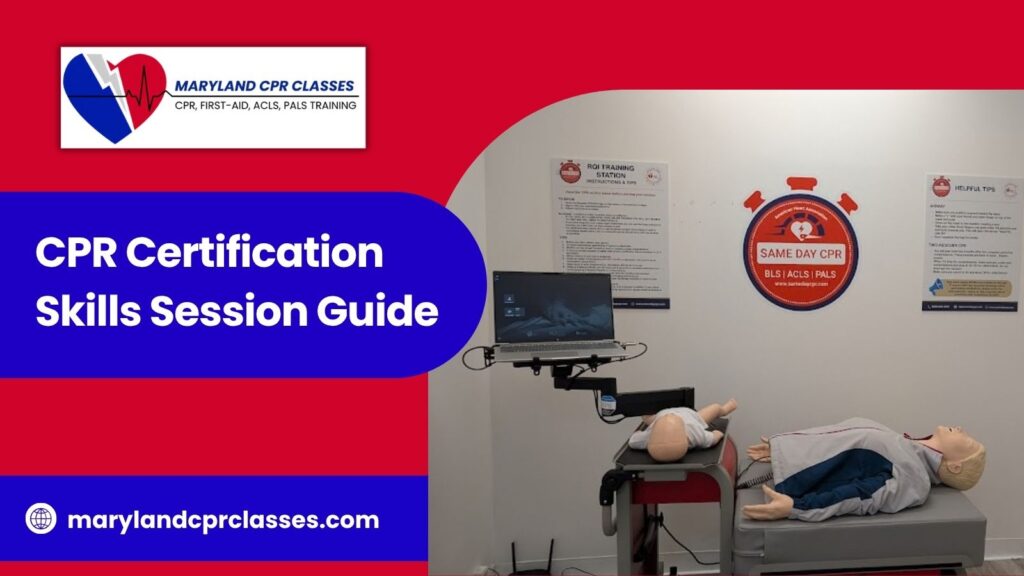
You’ll start with Self-Guided Learning, completing your course’s online material at your own pace, from any device. From there, you’ll visit a CPR Verification Station near you for a short, in-person skills session using Voice-Assisted Manikins, which give real-time feedback on your compression depth and rate as you complete your hands-on skills test.
Pass your skills check and you’ll receive your official AHA eCard the same day. Maryland CPR Classes operates locations across the state, including Annapolis, Baltimore City, Bethesda, Columbia, Frederick, Gaithersburg, Hagerstown, Salisbury, Silver Spring, Towson, and Ocean City.
How Long Does Heartsaver Certification Last?
Heartsaver certification is valid for two years from the completion date. After that, you’ll need to recertify to keep your card current, following the same process as your original course.
Group Training for Schools, Gyms, and Businesses
Schools, gyms, sports leagues, and businesses that need to certify a whole staff or coaching group at once can run into scheduling headaches trying to book individual sessions. Maryland CPR Classes offers group and on-site training, along with CPR Verification Station rentals, so organizations can get everyone certified together on a schedule that works for them.
You Don’t Need a Medical Background to Save a Life
That’s really the point of Heartsaver. It’s built for the moment you never plan for, whether that’s a student in your classroom, a client mid-workout, or a stranger in a parking lot. Maryland CPR Classes runs Heartsaver sessions across the state with same-day AHA eCards, so getting prepared doesn’t have to sit on your to-do list any longer than it needs to.
Frequently Asked Questions
What’s the difference between Heartsaver CPR AED and Heartsaver First Aid CPR AED?
Heartsaver CPR AED covers CPR, AED use, and choking relief. Heartsaver First Aid CPR AED includes all of that plus a broader first aid module covering injuries like burns, sprains, and bleeding.
Is Heartsaver the same as BLS?
No. Heartsaver is built for people without a medical background, while BLS is built for healthcare professionals and includes team-based resuscitation skills. If your job is clinical, you likely need BLS instead.
Can my school, gym, or business set up group Heartsaver training?
Yes. Maryland CPR Classes offers group and on-site training, along with CPR Verification Station rentals, for organizations certifying multiple people at once.
Can I complete Heartsaver certification entirely online?
The coursework can be completed online, but a hands-on skills session is always required in person before your certification is issued.